|
PHYS 025-01
General Physics 2
Course Syllabus Fall 2020
Professor: Dr. Joseph F. Alward
Email: JAlward@pacific.edu
(209) 406-4467 (Cell phone)
Office Hours: Every day--seven days, 9:00 A.M. until 7:30 P.M.
Textbook is online. Links to the sixteen chapters are below.
|
Topics: waves and sound, electric forces, electric potential and electric potential energy, electric circuits, magnetic forces, electromagnetic induction, electromagnetic waves, reflection and refraction of light, special relativity, quantum mechanics, particles and waves, atomic and nuclear physics, radioactivity.
|
|
|
|
|
|
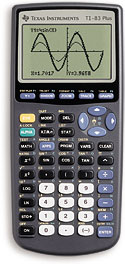
Calculator: Students may use whatever calculator they wish on quizzes and examinations. A commonly-used calculator is the one shown at the right, the TI-83+, or a later model, such as the TI-84/85/86.
TI 83+ Solver Instructions
TI 84+ Solver Instructions
TI-84 C Silver Edition
TI 85 Solver Instructions
The calculators listed above are especially helpful in solving algebraic equations.
|
|
|
Examinations (400 points): There are four 75-minute, open-book, online examinations. The exams will consist of 20 multiple-choice answer questions. .
The final examination (described below) score will replace the lowest of the students' four exam scores, provided the final exam score is higher than the lowest exam score. Note: For those students who otherwise would get a D+ or lower in the course based on the single-exam replacement rule, the lower two exam scores for those students will be replaced by the final exam score, providing the final exam score is higher than both scores. In such an event, C- is the highest grade that will be awarded.
There are no make-up, late, or early exams; if a student doesn't take the exam on the day, and at the time scheduled, that missed examination score will be replaced by whatever score the student receives on the comprehensive final exam.
Quizzes
Dates of the exams are to be announced.
Final Examination (100 points)
The final examination is three hours long and covers all of the material presented in lecture and must be taken at the assigned time. It consists of 33 multiple-choice answer questions.
The final exam score is used not only to replace the lowest exam score--if one of the first four exam scores is lower than the final exam score, but also counts as the fifth examination. Thus, there are five exam scores with a total possible value of 500 points. Some students might end up with more than 500 points on the five exams because of the curving of the exam scores.
The final exam is worth 100 points. In rare cases, owing to curving, some students may have gotten exam scores higher than 100,and might, by the time of the final, already have more than the 92% of the course total of 620 points needed to receive an "A" in the class (571 points or more). In such a case, the student would not need to take the final exam, since he or she will be awarded an "A" whether the final is taken, or not. In other cases, students might only need a dozen or so points on the final exam to earn an "A."
Laboratory (120 points): Contact the Lab Director, Prof. Gerald Hyatt, for information about the laboratory portion of this course.
Grading: Your course grade will be based on following percentage scale. The number of points possible will be the sum of the four unit exams (4 x 100), the final exam (100), the laboratory (120), and however many points are possible for the various quizzes given (to be determined).
Letter
Grade |
Percent
Required |
|
|
|
|
|
|
|
|
|
|
|
|
|
|
|
|
|
|
|
|
|
|
Course Schedule
Tuesday |
Thursday |
Aug 25 |
Aug 27 |
Sep 1 |
Sep 3 |
Sep 8 |
Sep 10 |
Sep 15 |
Sep 17 |
Sep 22 |
Sep 24 |
Sep 29 |
Oct 1 |
Oct 6 |
Oct 8 |
Oct 13 |
Oct 15 |
Oct 20 |
Oct 22 |
Oct 27 |
Oct 29 |
Nov 3 |
Nov 5 |
Nov 10 |
Nov 12 |
Nov 17 |
Nov 19 |
Nov 24 |
Nov 26
Holiday
|
Dec 1 |
Dec 3 |
Dec 8 |
Dec 10 |
| Monday |
Wednesday |
Friday |
| Aug 24 |
Aug 26 |
Aug 28 |
| Aug 31 Holiday |
Sep 2 |
Sep 4 |
| Sep 7 |
Sep 9 |
Sep 11 |
| Sep 14 |
Sep 16
|
Sep 18 |
| Sep 21 |
Sep 23 |
Sep 25 |
| Sep 28 |
Sep 30 |
Oct 2 Holiday |
| Oct 5 |
Oct 7 |
Oct 9 |
Oct 12
|
Oct 14 |
Oct 16 |
| Oct 19 |
Oct 21
|
Oct 23 |
| Oct 26 |
Oct 28 |
Oct 30 |
| Nov 2 |
Nov 4 |
Nov 6 |
| Nov 9 |
Nov 11 |
Nov 13 |
| Nov 16 |
Nov 18 |
Nov 20 |
| Nov 23 |
Nov 25 Holiday |
Nov 27 Holiday |
| Nov 30 |
Dec 2 |
Dec 4 Review |
| Dec 7 |
Dec 9
|
Dec 11 |
The College of the Pacific Honor Code Policy
Approved by COP Council: November, 2009
The College of the Pacific holds all of its students to a strict standard of academic integrity. In the case of a suspected violation of the University academic honor code, the faculty member and the chair of the department will evaluate the alleged infraction and report it immediately to both the chair of the department, the College Academic Affairs office and the Office of Judicial Affairs, which will begin a formal investigation. If the Office of Judicial Affairs determines that the student is responsible for the honor code violation, the standard penalty in the College is failure of the assignment and/or the course. In such cases, the student will be prevented from dropping or withdrawing from the course, even if the deadline to do so has not expired. Further disciplinary action may also be taken by the Office of Judicial Affairs.
|
|
|